**Target Ladders Dyscalculia
Characteristic features of dyscalculia are difficulties in the learning and understanding of number and number facts. Children experiencing these difficulties invariably become anxious when faced with any activity that involves arithmetic or calculations and will actively try to avoid them and can affect a child’s ability to access school curriculum and their ability to learn.
Using Target Ladders: Dyscalculia will enable teachers, teaching assistants and SENCOs to identify appropriate learning goals for independent learning, to adapt the suggested strategies or ideas for their own pupils, and to begin to impact on the child’s individual needs in order to close the gap between these children and their peers.
Target Ladders: Dyscalculia provides ‘small steps’ targets and helpful strategies based on eight key aspects of challenge to help and support children with dyscalculia:
oAspect 1: Foundation skills
oAspect 2: The number system
oAspect 3: Addition and subtraction
oAspect 4: Multiplication and division
oAspect 5: Shape and measure
oAspect 6: Money and problem solving
oAspect 7: Data handling
oAspect 8: Behaviours for learning
Product Information
Product Information
Shipping & Returns
Shipping & Returns
**Target Ladders Dyscalculia
**Target Ladders Dyscalculia
Characteristic features of dyscalculia are difficulties in the learning and understanding of number and number facts. Children experiencing these difficulties invariably become anxious when faced with any activity that involves arithmetic or calculations and will actively try to avoid them and can affect a child’s ability to access school curriculum and their ability to learn.
Using Target Ladders: Dyscalculia will enable teachers, teaching assistants and SENCOs to identify appropriate learning goals for independent learning, to adapt the suggested strategies or ideas for their own pupils, and to begin to impact on the child’s individual needs in order to close the gap between these children and their peers.
Target Ladders: Dyscalculia provides ‘small steps’ targets and helpful strategies based on eight key aspects of challenge to help and support children with dyscalculia:
oAspect 1: Foundation skills
oAspect 2: The number system
oAspect 3: Addition and subtraction
oAspect 4: Multiplication and division
oAspect 5: Shape and measure
oAspect 6: Money and problem solving
oAspect 7: Data handling
oAspect 8: Behaviours for learning
Original: $36.50
-65%$36.50
$12.77Product Information
Product Information
Shipping & Returns
Shipping & Returns
Description
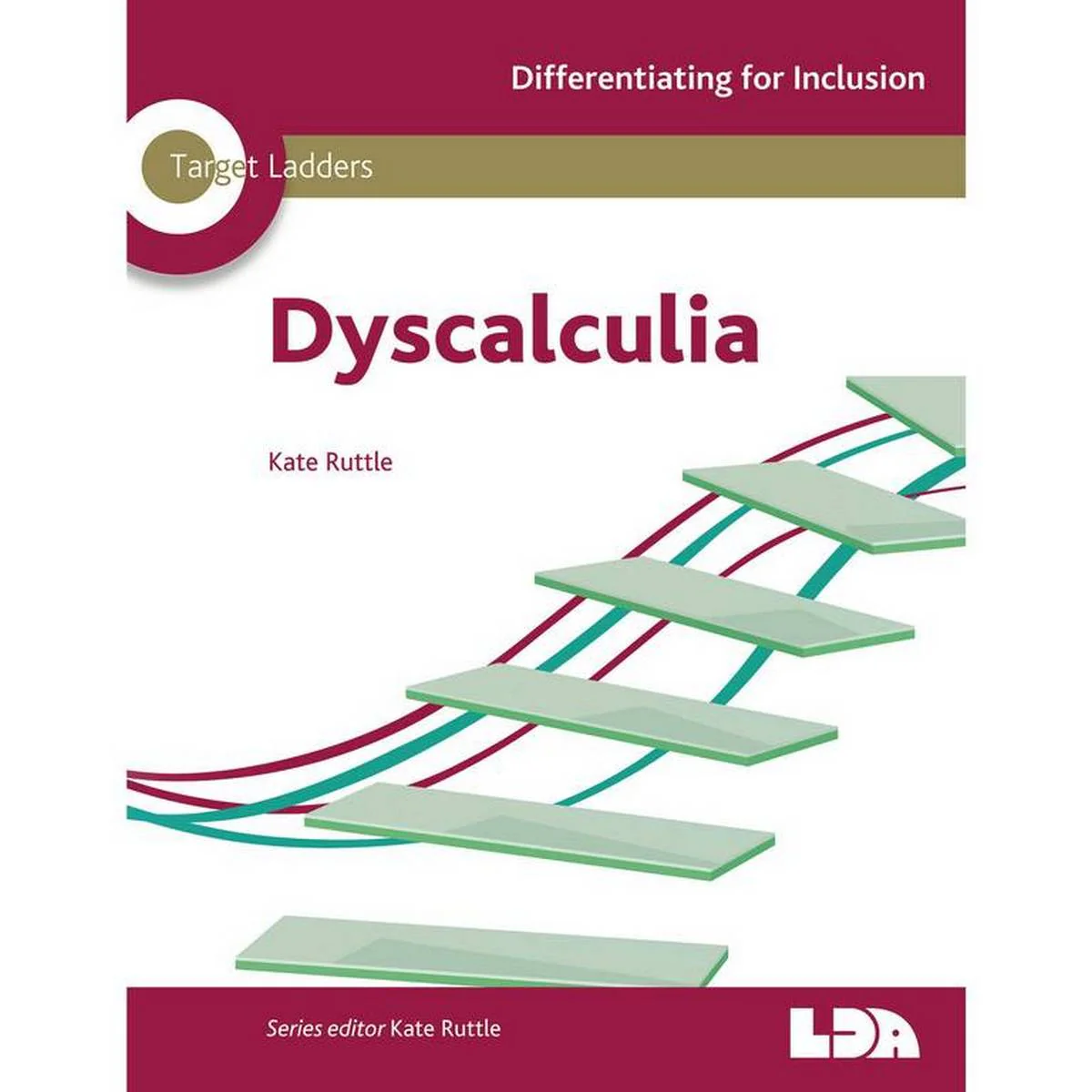
Characteristic features of dyscalculia are difficulties in the learning and understanding of number and number facts. Children experiencing these difficulties invariably become anxious when faced with any activity that involves arithmetic or calculations and will actively try to avoid them and can affect a child’s ability to access school curriculum and their ability to learn.
Using Target Ladders: Dyscalculia will enable teachers, teaching assistants and SENCOs to identify appropriate learning goals for independent learning, to adapt the suggested strategies or ideas for their own pupils, and to begin to impact on the child’s individual needs in order to close the gap between these children and their peers.
Target Ladders: Dyscalculia provides ‘small steps’ targets and helpful strategies based on eight key aspects of challenge to help and support children with dyscalculia:
oAspect 1: Foundation skills
oAspect 2: The number system
oAspect 3: Addition and subtraction
oAspect 4: Multiplication and division
oAspect 5: Shape and measure
oAspect 6: Money and problem solving
oAspect 7: Data handling
oAspect 8: Behaviours for learning