Points Of View Activity Set
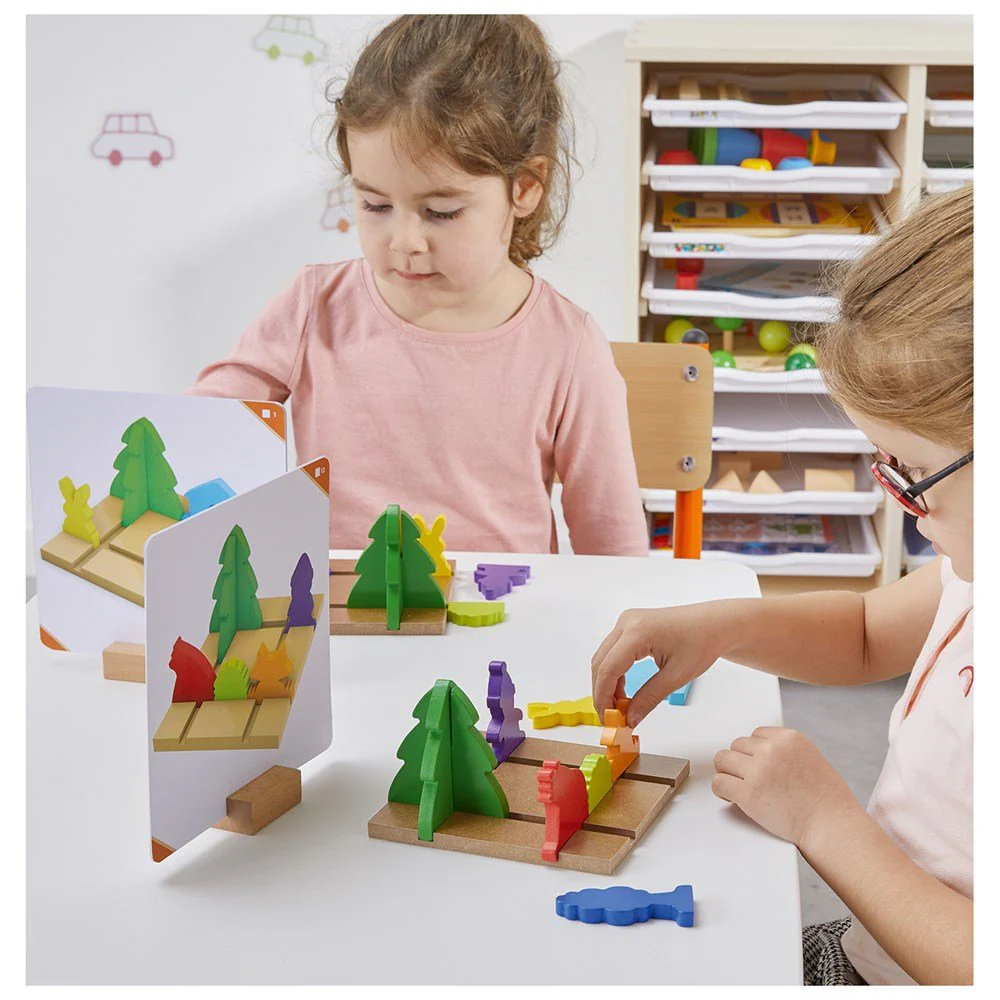
The "Points of View" workshop for 2 children leads them to perceive that an object can be seen differently depending on their position relative to the object.
Levels: MS - GS
Presentation :
Through manipulation, observation, and comparison of representations, children become familiar with different points of view: perspective, top view, and front view.
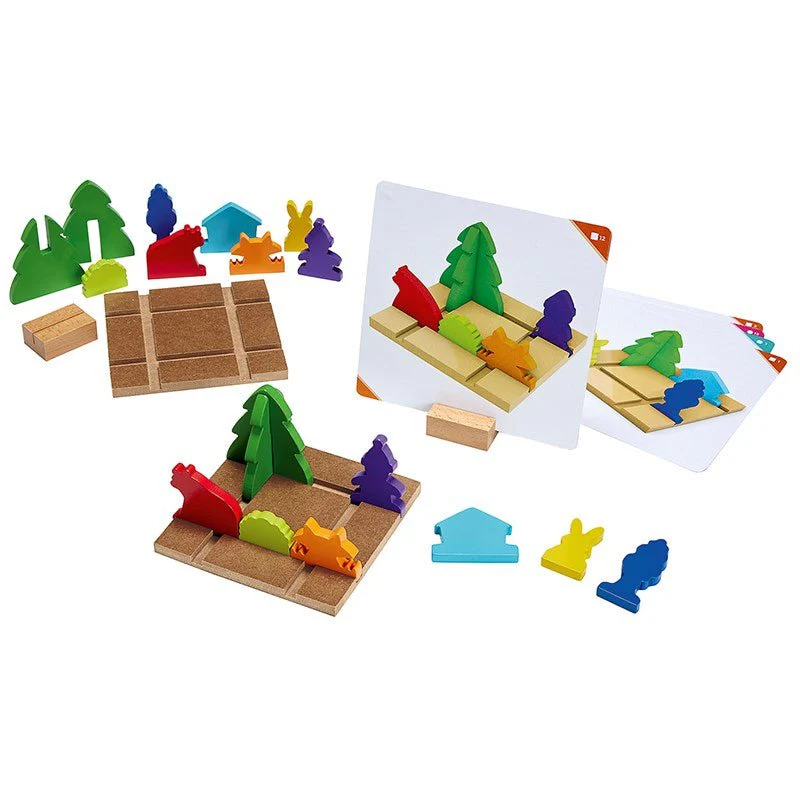
Children insert the figurative shapes into the grooved tray to reproduce the situation shown on the card.
This exploratory work leads them to make hypotheses, test them through trial and error, and develop their logical thinking.
PROGRESSION OF ACTIVITIES
The 18 double-sided cards (36 activities) are organized into 3 series of increasing difficulty.
Each card presents the same configuration (front/back) from two points of view to allow the child to self-correct.
- Series ■ ●: Perspective view
- Series ■: Top view
- Series ●: Front view
The child can use the object as a guide by placing it on the card (same scale).
SKILLS DEVELOPED
- Locate objects in space and position them in relation to each other.
- To locate an object according to its orientation, from different points of view.
- Positioning an object from a given viewpoint.
- To perceive the relationships between a 3D space and a 2D representation.
- Use appropriate spatial vocabulary: in front, behind, to the right, to the left, etc.
Product Information
Product Information
Shipping & Returns
Shipping & Returns
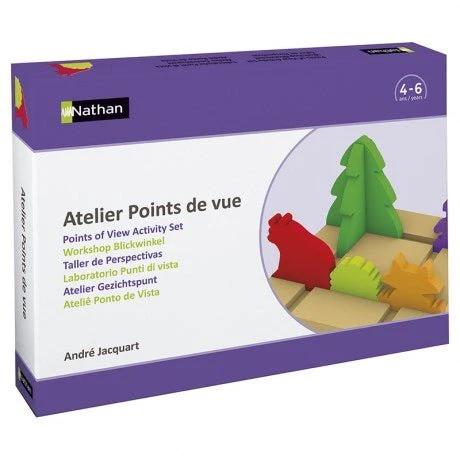
Points Of View Activity Set
Points Of View Activity Set
The "Points of View" workshop for 2 children leads them to perceive that an object can be seen differently depending on their position relative to the object.
Levels: MS - GS
Presentation :
Through manipulation, observation, and comparison of representations, children become familiar with different points of view: perspective, top view, and front view.
Children insert the figurative shapes into the grooved tray to reproduce the situation shown on the card.
This exploratory work leads them to make hypotheses, test them through trial and error, and develop their logical thinking.
PROGRESSION OF ACTIVITIES
The 18 double-sided cards (36 activities) are organized into 3 series of increasing difficulty.
Each card presents the same configuration (front/back) from two points of view to allow the child to self-correct.
- Series ■ ●: Perspective view
- Series ■: Top view
- Series ●: Front view
The child can use the object as a guide by placing it on the card (same scale).
SKILLS DEVELOPED
- Locate objects in space and position them in relation to each other.
- To locate an object according to its orientation, from different points of view.
- Positioning an object from a given viewpoint.
- To perceive the relationships between a 3D space and a 2D representation.
- Use appropriate spatial vocabulary: in front, behind, to the right, to the left, etc.
Product Information
Product Information
Shipping & Returns
Shipping & Returns
Description
The "Points of View" workshop for 2 children leads them to perceive that an object can be seen differently depending on their position relative to the object.
Levels: MS - GS
Presentation :
Through manipulation, observation, and comparison of representations, children become familiar with different points of view: perspective, top view, and front view.
Children insert the figurative shapes into the grooved tray to reproduce the situation shown on the card.
This exploratory work leads them to make hypotheses, test them through trial and error, and develop their logical thinking.
PROGRESSION OF ACTIVITIES
The 18 double-sided cards (36 activities) are organized into 3 series of increasing difficulty.
Each card presents the same configuration (front/back) from two points of view to allow the child to self-correct.
- Series ■ ●: Perspective view
- Series ■: Top view
- Series ●: Front view
The child can use the object as a guide by placing it on the card (same scale).
SKILLS DEVELOPED
- Locate objects in space and position them in relation to each other.
- To locate an object according to its orientation, from different points of view.
- Positioning an object from a given viewpoint.
- To perceive the relationships between a 3D space and a 2D representation.
- Use appropriate spatial vocabulary: in front, behind, to the right, to the left, etc.