Making Numbers: Using Manipulatives To Teach Arithmetic
Making Numbers shares exemplars of good practice drawing on the latest research on using manipulatives to develop understanding of arithmetic. Focusing initially on the teaching of numbers from 1-12, Making Numbers progresses to 200 and beyond, including ideas for teaching partitioning, arrays, and times tables.
Making Numbers was written by experts with decades of experience in primary mathematics education, Professor Rose Griffi ths, Dr. Sue Gifford and Dr. Jenni Back, based on their Nuffield Foundation funded research and development project Using Manipulatives in the Foundations of Arithmetic.
Features
- Provides practical suggestions on how to develop number sense using practical resources
- Photographs exemplify how to use the manipulatives
- Each successive chapter builds on children's understanding gained with smaller numbers
- Underpinned by educational research and classroom practice
- Paperback | 112 pages
- 190 x 246 x 7mm | 328g
- 29 Sep 2016
- Oxford University Press
- Oxford, United Kingdom
- English
Product Information
Product Information
Shipping & Returns
Shipping & Returns
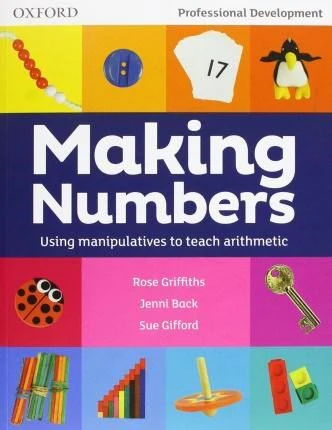
Making Numbers: Using Manipulatives To Teach Arithmetic
Making Numbers: Using Manipulatives To Teach Arithmetic
Making Numbers shares exemplars of good practice drawing on the latest research on using manipulatives to develop understanding of arithmetic. Focusing initially on the teaching of numbers from 1-12, Making Numbers progresses to 200 and beyond, including ideas for teaching partitioning, arrays, and times tables.
Making Numbers was written by experts with decades of experience in primary mathematics education, Professor Rose Griffi ths, Dr. Sue Gifford and Dr. Jenni Back, based on their Nuffield Foundation funded research and development project Using Manipulatives in the Foundations of Arithmetic.
Features
- Provides practical suggestions on how to develop number sense using practical resources
- Photographs exemplify how to use the manipulatives
- Each successive chapter builds on children's understanding gained with smaller numbers
- Underpinned by educational research and classroom practice
- Paperback | 112 pages
- 190 x 246 x 7mm | 328g
- 29 Sep 2016
- Oxford University Press
- Oxford, United Kingdom
- English
Product Information
Product Information
Shipping & Returns
Shipping & Returns
Description
Making Numbers shares exemplars of good practice drawing on the latest research on using manipulatives to develop understanding of arithmetic. Focusing initially on the teaching of numbers from 1-12, Making Numbers progresses to 200 and beyond, including ideas for teaching partitioning, arrays, and times tables.
Making Numbers was written by experts with decades of experience in primary mathematics education, Professor Rose Griffi ths, Dr. Sue Gifford and Dr. Jenni Back, based on their Nuffield Foundation funded research and development project Using Manipulatives in the Foundations of Arithmetic.
Features
- Provides practical suggestions on how to develop number sense using practical resources
- Photographs exemplify how to use the manipulatives
- Each successive chapter builds on children's understanding gained with smaller numbers
- Underpinned by educational research and classroom practice
- Paperback | 112 pages
- 190 x 246 x 7mm | 328g
- 29 Sep 2016
- Oxford University Press
- Oxford, United Kingdom
- English